
A Kelvin label can look settled while the grey-blue wallpaper still fails under the ordered fixture. Approve the exact wallcovering and LED pairing in the project room before either order becomes noncancelable.
Test Grey-Blue Wallpaper Under LED Light Before Fixing Color Temperature shown with practical context cues.
Grey-blue wallpaper must be tested under the specified LED source before color temperature is approved
The exact fixture, LED engine, optic, diffuser, driver, dimmer, and output control the approval. A showroom lamp or loose bulb cannot stand in for that system.
| Check | Kelvin-only selection | Exact-source room test |
|---|---|---|
| Spectrum | Assumed from stated CCT | Checked with source SPD and wall sample |
| Chromaticity | Nominal CCT only | Measured CCT, Duv, and production tolerance |
| Dimming | Full-output label | Full output and intended dimmed scenes |
| Texture | Small sample under broad light | Full repeats under the scheduled beam direction |
| Production lot | Sample status unknown | Production-representative sample documented |
| Daylight | Showroom conditions | Project window exposure tested |
| Mirror view | Usually omitted | Direct and reflected views checked |
Why can two LEDs with the same CCT render grey-blue wallpaper differently?
Equal nominal CCT does not mean equal spectral power distribution. Different spectral peaks can make the wallpaper inks and coating read green, violet, dull, or clear even when both cartons say 3000K or 4000K.
The U.S. Department of Energy identifies its Spectral Calculator as the TM-30 reference implementation for calculating metrics from spectral power distribution data. A continuous spectrum can be converted into tristimulus values, but the resulting report still does not decide which installed appearance the owner prefers.
CIE colorimetry data identify CIE 015:2018 procedures and standard illuminants D50, D65, and A. The registry provides observer data over 360 to 780 nm and illuminant data over 300 to 780 nm at 1 nm or 5 nm intervals. Many color-management instruments instead supply 10 nm data, so mismatched ranges and intervals need the procedures in CIE Publication 15.
Why is a showroom approval unreliable for the project wall?
A showroom changes the lamp, sample size, surroundings, and viewing angle. The project wall adds fixture distance, beam direction, daylight, vanity paint, flooring, metal, and mirror reflection. Spectral reports and showroom checks cannot guarantee the preferred installed appearance.
The approval sheet should identify the wallpaper manufacturer, pattern, colorway, substrate, coating, texture, lot status, and current-production confirmation. Confirm that the manufacturer permits the wallcovering in the proposed room under the expected moisture and cleaning conditions. Rooms containing sensitive collections may also need the preservation and documentation approach set out in the National Park Service Museum Handbook.
Grey-blue wallpaper must be tested under the specified LED source before color temperature is approved shown as an editorial planning reference.
The next step is a mockup that preserves the actual wall, seams, pattern direction, and light geometry.
How should a room-side grey-blue wallpaper lighting mockup be built?
Mount a production-representative sample flat on the project wall or on a rigid board built to match it. Show several pattern repeats and place each candidate luminaire at its scheduled position.
The grey-blue wallpaper sample must match the intended production roll
- Confirm the sample size. Follow the minimum set by the wallcovering manufacturer or designer. Show enough repeats to expose the full color range, seams, and directional marks.
- Match the wall build. Record the substrate color, primer, liner, adhesive, seam direction, and hanging orientation. A white test board can affect the reading of thin paper.
- Identify the material. Record the pattern, colorway, lot or run, and sample date. Ask how one production lot can be reserved.
- Check each stage. Compare the memo sample, strike-off, approval sample, and delivered roll under the same source. Retest a delivered lot that differs from the retained sample.
The grey-blue wallpaper mockup must preserve pattern direction and surface texture
- Follow the hanging direction and pattern-match instructions. Mark the top edge and planned seams.
- Aim the light across embossed, woven, metallic, pearlescent, or raised areas at the installed angle.
- Match the mounting height, setback, aiming angle, beam spread, diffuser, and sample distance.
- Keep flooring, vanity, countertop, trim, paint, and mirror samples in their planned positions.
- Inspect from the doorway, vanity, standing position, seated position, and floor mirror.
- Use photographs to document the setup, not to approve color.
Visual color judgments can vary between observers. Instrument readings provide a quantitative record, although the cited review of colorimetric methods concerns pharmaceutical materials rather than wallpaper. The installed visual check still controls the decision.
Which LED specifications matter when grey-blue wallpaper changes color?
Compare the exact source spectrum, chromaticity, Duv, TM-30 data, production tolerance, driver, and dimming behavior. Mark missing information as “not supplied.” Never estimate it.
| Field | Candidate A | Candidate B |
|---|---|---|
| Manufacturer | Not supplied | Not supplied |
| Model | Not supplied | Not supplied |
| LED engine | Not supplied | Not supplied |
| Nominal and measured CCT | Not supplied | Not supplied |
| Duv and tolerance | Not supplied | Not supplied |
| TM-30 Rf and Rg | Not supplied | Not supplied |
| Relevant hue-bin data | Not supplied | Not supplied |
| SPD availability | Not supplied | Not supplied |
| Driver and dimming method | Not supplied | Not supplied |
| Minimum stable output | Not supplied | Not supplied |
| Report date | Not supplied | Not supplied |
CCT does not predict every grey-blue wallpaper color shift
Two sources with the same stated CCT can occupy different chromaticity points and have different spectra. Request measured CCT, coordinates, Duv, and the manufacturer’s tolerance. Confirm that the test data match the proposed LED engine, optic, diffuser, drive current, and operating condition.
IES TM-30 data can screen LED candidates before the wall test
ANSI/IES TM-30-24 uses related measures and graphics to communicate color rendition. Review Rf, Rg, the color vector graphic, and relevant hue bins together. Basic CRI describes similarity to a reference, while TM-30 adds fidelity, gamut, and graphical information about variation.
Reject reports tied to another LED engine or output setting. Then inspect each shortlisted source directly and through the floor mirror.
Grey-blue wallpaper must be checked in direct and floor-mirror views
Inspect the wallpaper from normal occupied positions and through every floor mirror. The reflected path can expose hot spots, texture shadows, and bright surfaces that the direct view hides.
Floor mirrors must not create false brightness around grey-blue wallpaper
A reflected fixture, window, pale ceiling, glossy floor, or white countertop can make the wall seem brighter without improving light on the wallpaper.
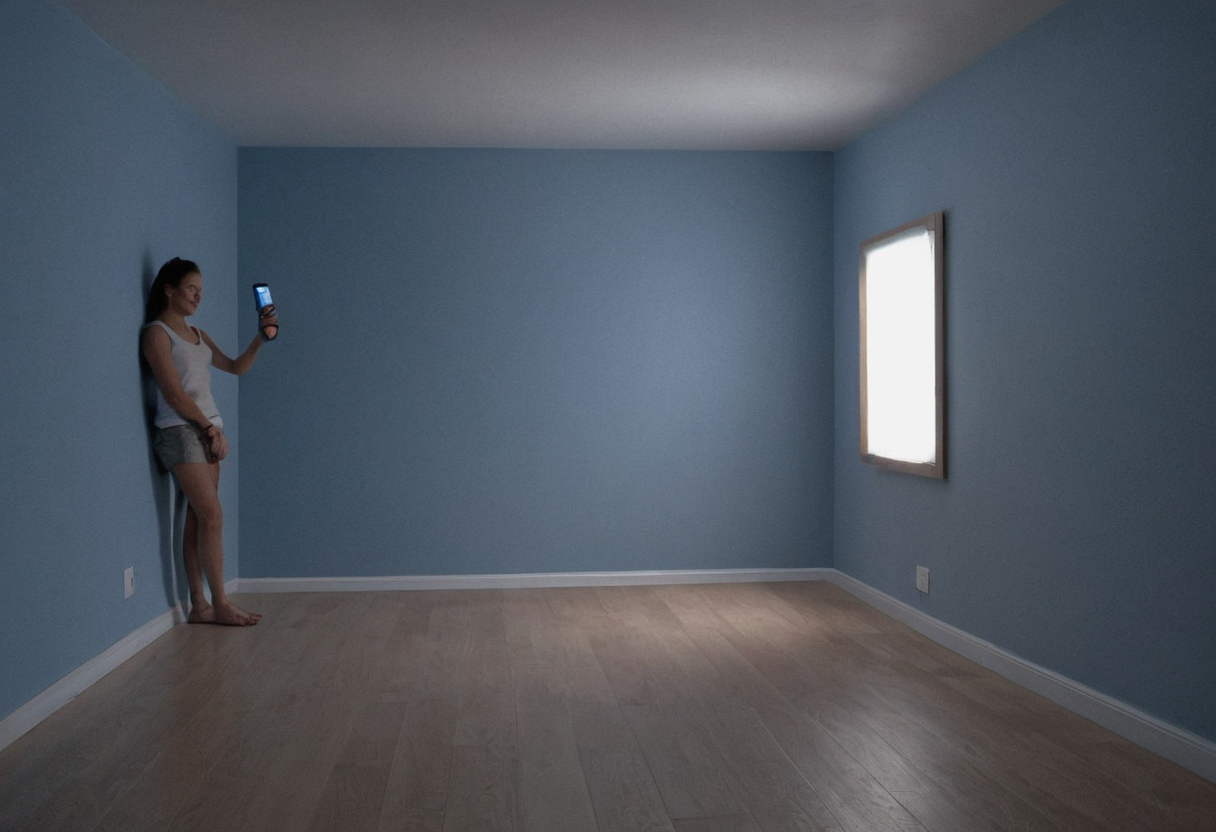
Grey-blue wallpaper must be checked in direct and floor-mirror views shown as an editorial planning reference.
- Mark observer positions and eye heights at the doorway, vanity, and standing points.
- Fix the mirror at its final position, lean angle, and mounting condition.
- Record the mirror dimensions, glazing, coating, tint, and frame finish.
- Identify every fixture and window visible in the mirror.
- Compare direct and reflected color while doors, shades, and blinds remain fixed.
- Record illuminance on the wallpaper rather than judging brightness from reflection alone.
This wallcovering check differs from testing skin and fabrics at a floor mirror. Use separate floor-mirror glare and false-brightness checks for reflected luminaires and hot spots.
Grazing LED light can emphasize grey-blue wallpaper texture and seams
Check the scheduled fixture setback, beam angle, and grazing direction against the wallpaper instructions. Reject geometry that turns acceptable embossing into heavy shadows or makes seams read as dark lines. Repeat the inspection under daytime, nighttime, and dimmed scenes.
Grey-blue wallpaper must pass daytime, nighttime, and dimmed LED tests
Run separate daylight-only, electric-only, and mixed-light tests. Test full output and every occupied dimmed scene. Judge the wallpaper at the lowest stable setting, not merely the driver’s advertised minimum.
Record room orientation, window exposure, exterior obstructions, shade position, test time, and sky condition. Exclude exterior daylight during the nighttime test and record illuminance on the wallpaper for each scene.
Dim-to-warm LEDs require separate approval for grey-blue wallpaper
A dim-to-warm LED intentionally changes output and color while dimming. Approve every occupied scene with the exact fixture, driver, dimmer, protocol, load, and fade settings. Review the manufacturer’s CCT-versus-output curve and available spectral data.
The Department of Energy describes IES TM-30 color-rendering information as related measures and graphics for characterizing sources. Those records help select a source, but they do not approve the wall.
Constant-CCT LEDs must still be checked at low output
A constant-CCT label does not prove stable low-output performance. Check the project driver and dimmer for visible color shift, flicker, dropout, pop-on, dead travel, and fixture-to-fixture mismatch. Measure low-output chromaticity if a shift appears.
Daylight and electric light must be tested separately and together
Record shade positions and control levels for every test. If one pairing cannot pass every condition, state which occupied scene has priority before issuing a final decision.
Record a pass-or-reject decision before ordering the grey-blue wallpaper and LEDs
Approve the pairing with a written matrix, not memory or phone photographs. Record the exact products, wallpaper lot, scenes, mirror position, daylight condition, observers, and accepted limits.
| Check | Record |
|---|---|
| Direct view | Daytime, nighttime, full output, and dimmed scenes |
| Mirror view | Position, angle, daytime, nighttime, and glare |
| Finish | Seams, texture, pattern, colorway, and lot |
| Lighting system | Fixture, engine, optic, driver, and control |
| Decision | Pass, conditional pass, or reject |
A pass meets every agreed occupied view. A conditional pass names the correction and requires a retest. A reject stops procurement. Name the final decision-maker and retain a wallpaper control sample.
Record a pass-or-reject decision before ordering the grey-blue wallpaper and LEDs shown with practical context cues.
Phone photographs cannot approve grey-blue wallpaper color
Direct project-room observation controls approval. Photographs only document the setup because camera processing, white balance, exposure, and screen calibration alter displayed color. If measurements are required, CIELab records lightness, the red-green axis, and the yellow-blue axis, while tristimulus colorimetry records X, Y, and Z values.
Any product substitution requires a new grey-blue wallpaper test
Retest any changed fixture, LED engine, optic, diffuser, driver, dimmer, mirror, wallpaper lot, adhesive, or wall location. Do not release either order until the exact installed pairing has a dated, written room-side approval.
Frequently asked questions
Is 6500K too blue for grey-blue wallpaper in a dressing room or powder room?
A 6500K label cannot answer that question alone. Test the exact source because its spectrum, Duv, output, daylight mix, and the wallpaper inks all affect the result.
Which looks whiter on grey-blue wallpaper, 4000K or 6000K LED light?
Neither CCT is guaranteed to look whiter. Compare production-representative wallpaper under both exact fixtures at full and dimmed output.
How can I confirm an LED’s actual color temperature before ordering fixtures?
Request measured CCT, chromaticity coordinates, Duv, production tolerance, report date, and the tested LED-engine code. Field measurement can confirm the installed source when manufacturer data are incomplete.
Should grey-blue wallpaper be approved in daylight, electric light, or both?
Approve daylight-only, electric-only, and mixed-light scenes. Include nighttime and every occupied dimming level.
Can a phone camera or white-balance setting show the true color of grey-blue wallpaper?
No phone setup can guarantee a true visual match. Use photographs for records and make the approval while viewing the actual sample in the project room.