
A navy jacket and black trousers can appear coordinated at the floor mirror, then separate under office light or daylight. The problem often begins with a bright ceiling fitting that delivers uneven vertical light or distorts critical colors. A dependable dressing room needs a measured color-evaluation station, not simply more brightness.
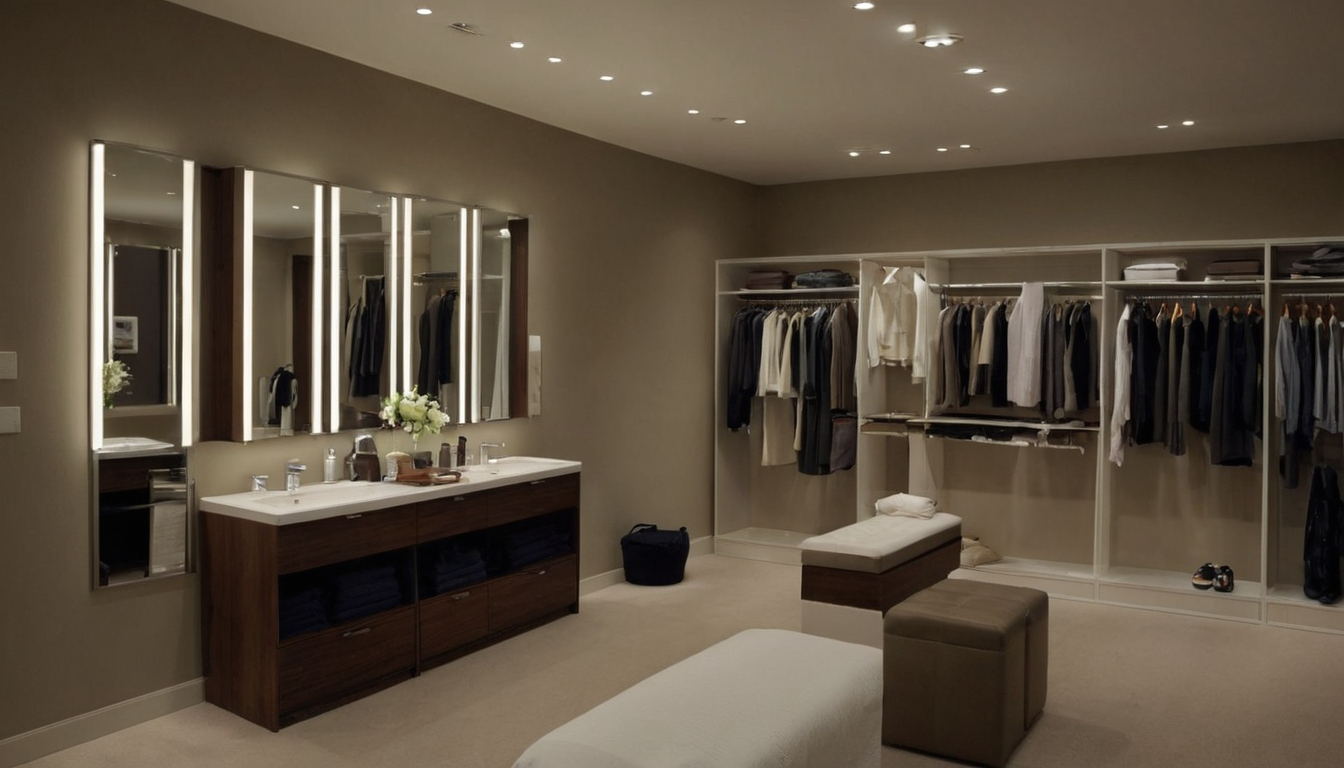
Selecting Dressing-Room Lighting When a Floor Mirror Must Render Fabrics and Skin Accurately shown as an editorial reference for proportion and finish coordination.
What lighting arrangement lets floor mirrors render skin and clothing reliably?
Floor mirrors need broad frontal light across the face, torso, hem, and footwear. Paired vertical sources are usually most dependable because they reduce overhead shadows and uneven color judgments.
Frontal lighting is more dependable than ceiling-only lighting at a full-length mirror
| Arrangement | Delivery | Shadow result | Suitable condition |
|---|---|---|---|
| Paired broad vertical sources | Light from both sides | Soft, balanced modelling | Preferred where space permits |
| One broad frontal source | Wide frontal light | Some directional shadow | Narrow rooms |
| Mirror-integrated light | Light near the reflection | Even when diffused | Limited wall space |
| Ceiling-only light | Mostly downward | Dark eyes, folds, and footwear | Circulation only |
Symmetrical light reduces misleading differences between the two sides of an outfit
Balanced left-right delivery makes tailoring, drape, leather, and fabric color easier to compare. Mirror width, cabinetry, and viewing position determine spacing. A narrow room may require one broad source, but its distribution should cover the entire user-facing plane.
For accessible projects, avoid obstructing the applicable 30 by 48 inch clear floor space specified by the U.S. Department of Justice. Where qualified products apply, ENERGY STAR states that qualified LED lighting uses at least 75 percent less energy and lasts up to 25 times longer than incandescent lighting.
Vertical illuminance at floor mirrors should be measured at face, torso, and footwear heights
Vertical illuminance at the user-facing plane is relevant because horizontal readings do not show how much light reaches skin and clothing.
How should vertical illuminance be measured in front of a floor mirror?
- Mark the actual viewing position and normal mirror distance.
- Use a calibrated, cosine-corrected illuminance meter and record its calibration status and uncertainty.
- Hold the sensor vertically at the user plane, facing the frontal luminaires rather than the mirror.
- Measure at face, upper-torso, hem, and footwear heights.
- Take left, centre, and right readings where delivery may be asymmetric.
- Test electric light alone and with representative daylight. Record blinds, finishes, dimming level, and preset.
Uniformity matters because a bright face and dim clothing prevent whole-outfit evaluation
One eye-level reading can conceal falloff from short strips, narrow wall lights, or ceiling optics that illuminate shoulders but leave trousers and shoes unresolved. Dark finishes, dark garments, older users, and low-vision users may justify broader coverage or higher project criteria.
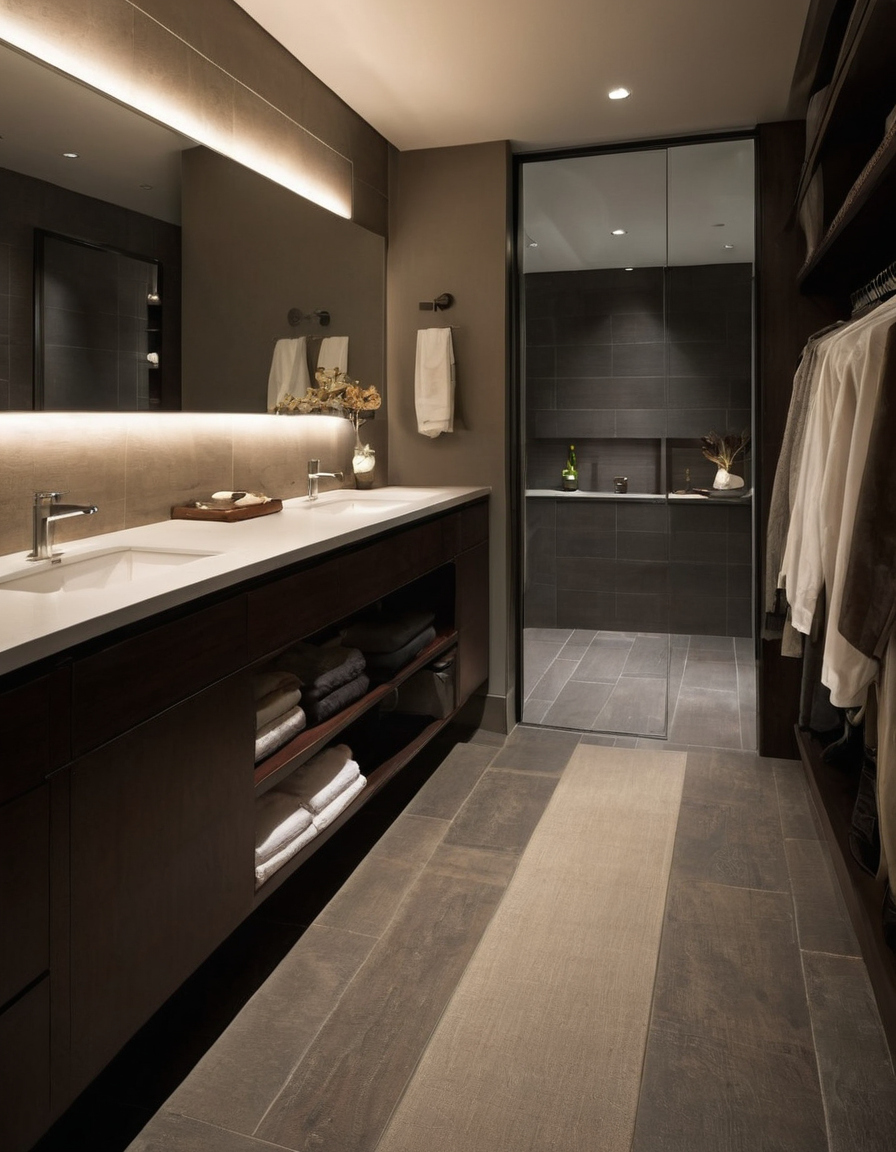
Vertical illuminance at floor mirrors should be measured at face, torso, and footwear heights shown with finish, fixture, and clearance relationships visible.
A qualified lighting designer should set maintained illuminance and acceptable variation after mock-up testing. No universal target applies independently of the room, users, finishes, and task.
Which color temperature is most useful for a residential dressing-room mirror?
The useful correlated color temperature is the one matched to the dominant destination condition. CCT describes chromatic appearance, not complete spectral equivalence or color-rendering quality.
Match the mirror-lighting mode to where the clothing will be seen
A warm evening reference commonly falls around 2700K to 3000K. A neutral 3500K to 4000K mode provides a practical reference for office clothing and general dressing. Around 5000K can support daylight comparisons, but an LED at that CCT is not automatically spectrally equivalent to daylight.
Room finishes also affect judgment. Warm timber can intensify reflected warmth, while dark paint can reduce reflected light. Test window daylight separately because textiles may match under one spectrum and separate under another.
Tunable-white lighting is useful only when every setting is specified and tested
Fixed white is often more reliable when one destination condition dominates. Tunable white is worthwhile only when the manufacturer provides color-rendering, chromaticity, output, and dimming data at warm, middle, and cool settings. Approve presets, driver compatibility, consistency, and vertical output in every mode.
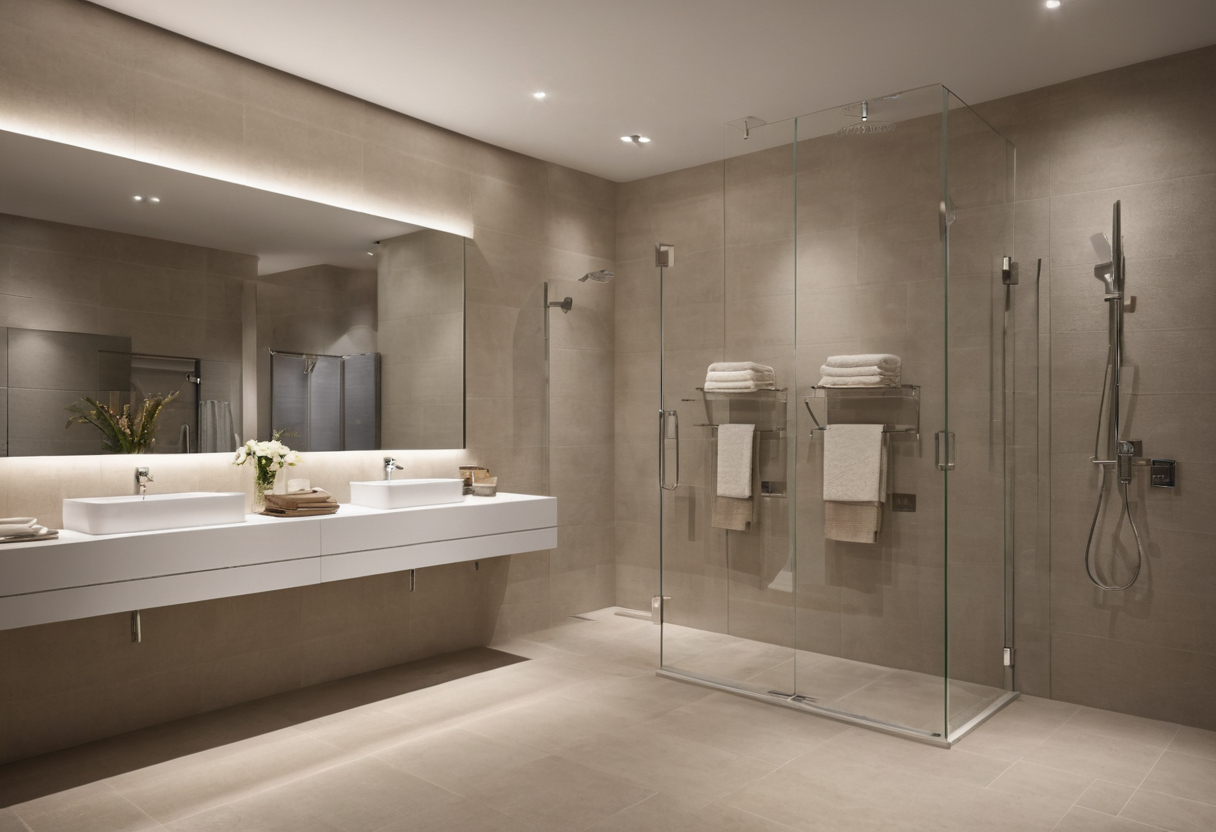
Which color temperature is most useful for a residential dressing-room mirror shown as an editorial reference for proportion and finish coordination.
Accurate fabric and skin rendering requires more than a high CRI label
High CRI alone cannot confirm accurate rendering. Specify TM-30 performance, saturated-red rendering, chromaticity consistency, and spectral power distribution for the exact LED module and operating condition.
IES TM-30 reveals hue shifts that a single CRI number can conceal
Sources with similar CRI ratings can render complexions, reds, blues, and neutrals differently. The Illuminating Engineering Society position on TM-30-18 describes Rf as an average fidelity measure analogous to CRI, while maintaining that Rf is superior for that purpose.
- Request the complete report: review Rf, Rg, and the color vector graphic.
- Check local hue shifts: look for compression, saturation, or rotation in important colors.
- Review saturated-red rendering: skin, leather, and red textiles can reveal weaknesses concealed by an average.
- Lock the test condition: record the LED version, CCT, driver, dimming level, coordinates, and binning.
Spectral power distribution determines whether similar fabrics still match under another light
Metamerism occurs when materials match under one spectrum but separate under another. Compare representative skin tones, navy and black textiles, leather, metals, and finishes under the proposed LED and at least one destination condition. Require spectral power distribution data for every tunable-white setting.
Luminaire placement must light the person without creating glare or distorted shadows
Luminaires should sit outside principal reflected sightlines while casting broad light toward the user’s front and sides. Exposed lamps, small intense sources, and narrow overhead beams can cause glare or hard shadows.
Why does overhead-only dressing-room lighting look unflattering?
Ceiling-only lighting concentrates illumination on the head and shoulders rather than the vertical viewing plane. The result can include dark eye sockets, chin shadows, exaggerated folds, and unresolved footwear.
- Recessed downlights: use broad, shielded optics to supplement frontal light.
- Vertical sconces or luminous mirror edges: check balance and reflected-source visibility.
- Track lighting: aim broad beams across the user, not into the mirror.
- Indirect coves: treat them as background light unless photometric data confirms vertical coverage.
Record the mirror, standing position, ceiling, and cabinetry on a scaled layout, then check beam spread and shielding. Consult the separate floor-mirror placement, glare, and reflected-brightness guidance for sightline planning.
Floor-mirror lighting should be coordinated before electrical and joinery positions are fixed
Confirm the mirror, standing position, and luminaires before locating electrical boxes, controls, doors, shelving, and anchors. Coordinate mounting tolerances, driver access, and local requirements before rough-in. Test the complete arrangement before procurement.
A dressing-room lighting mock-up should be approved with real garments before procurement
Approve the specification using the proposed mirror, luminaires, controls, finishes, and representative garments. Combine instrument readings, visual comparison, product documentation, and recorded scenes.
What should be included in a floor-mirror color-rendering test kit?
Include varied skin tones, black and navy textiles, reds, neutrals, patterns, leather, metallic accessories, glossy finishes, and a neutral reference card.
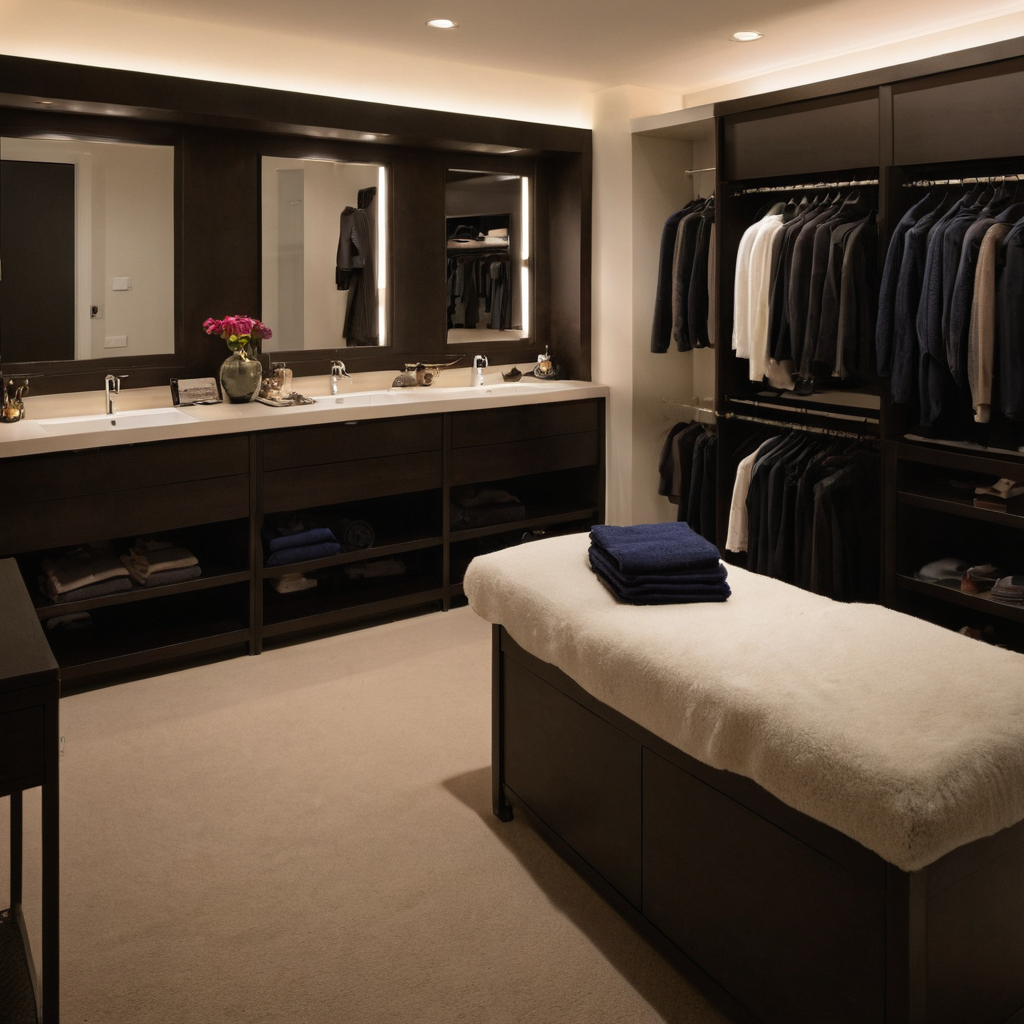
A dressing-room lighting mock-up should be approved with real garments before procurement shown as a planning reference for layout, scale, and material decisions.
- Measure face, torso, hem, and footwear illuminance under every preset.
- Compare garments with destination lighting or daylight without mixed sources.
- Record product codes, settings, readings, daylight conditions, and approved scenes.
The approved LED, driver, dimmer, and optic must be treated as one system
Procurement must retain the tested LED module, driver, dimmer, optic, control protocol, product codes, and revisions. Review substitutions for spectrum, output, distribution, dimming, flicker, and color consistency, not merely wattage and CCT. Buy the measured system, not a nominally similar fitting.
Frequently asked questions
What is the best lighting arrangement for a dressing room with a full-length floor mirror?
Paired broad vertical sources usually provide the most balanced frontal delivery. One broad source can work where measurements confirm full-height coverage.
Why does overhead dressing-room lighting make skin and clothing look unflattering?
Overhead light favors horizontal surfaces and can shadow the eyes, chin, torso, lower garments, and shoes.
Can dressing-room lighting and mirror placement change the apparent proportions of an outfit?
Yes. Directional shadows, asymmetric lighting, mirror tilt, and viewing distance can exaggerate folds or create false differences.
What should be checked when choosing a ceiling light for a dressing room?
Check beam distribution, shielding, reflected glare, vertical coverage, dimming compatibility, flicker, and its relationship to frontal lighting.
Is high CRI enough to ensure that fabrics and skin look accurate in a floor mirror?
No. Review TM-30 data, saturated-red rendering, spectral power distribution, chromaticity consistency, and real samples under the dressing-room source and destination lighting.