
A designer, client, and electrician may agree that a floor mirror looks elegant, then notice a reflected downlight sitting at eye height in the glass. The issue is not only where the mirror looks best, but where it can sit without sending glare from a lamp, window, or ceiling aperture back into the room.
Where should floor mirrors sit in a lighting plan to avoid glare?
Floor mirrors should sit where they reflect controlled surfaces, not bare lamps, bright window patches, or unshielded downlights. In bedrooms, dressing rooms, living rooms, hallways, and hotel suites, the safer position is usually outside the direct viewing cone between the user’s eye, the mirror, and the brightest source.
Direct glare occurs when the eye sees the lamp, downlight aperture, pendant globe, LED strip, or sun patch directly. Reflected glare occurs when a floor mirror sends that same bright image back from another angle. It is often missed because the luminaire looks clear of the main seating or dressing position while the mirror creates a second sightline.
- Bedroom risk: a mirror facing the bed can reflect a downlight or bedside lamp at pillow height.
- Dressing-room risk: a mirror beside wardrobes can catch vertical LED strips, exposed cabinet lighting, or a bright sconce.
- Hallway risk: a mirror at the end of a corridor can reflect a row of recessed downlights.
- Living-room risk: a mirror angled toward a sofa can reflect a pendant, table lamp opening, or daylight patch.
LED efficiency does not remove the glare problem. ENERGY STAR states that qualified LED lighting uses at least 75 percent less energy and lasts up to 25 times longer than incandescent lighting, but an efficient LED can still produce a sharp reflected image if the emitter, lens, or aperture is visible in the glass.
A floor mirror should reflect lit walls before it reflects luminaires
A floor mirror works best when the reflected image is a softly lit wall, curtain, wardrobe face, timber panel, artwork wall, or indirect cove. The mirror then extends perceived brightness without showing the source. A matte plaster wall with wall washing, a fabric curtain with side light, or a satin wardrobe door gives a calmer reflected field than a visible pendant or exposed LED tape.
Risk rises when the mirror catches a small bright source against a darker room. A recessed aperture, bare pendant lamp, visible LED strip, or direct sun patch can become a hot spot. Gloss paint, polished stone, lacquered joinery, and glass-topped furniture add secondary reflections, so the designer should check the mirror image and surrounding surfaces.
Surface care can affect long-term glare. The Natural Stone Institute recommends neutral cleaners, stone soap, or mild liquid dishwashing detergent and warm water for natural stone, and warns that scouring powders or creams can scratch stone because they contain abrasives.
Dressing areas need strict placement because the user stands close to the glass and searches the reflection for detail. This is why bespoke dressing-room planning depends on technical decisions: wardrobe lighting, fabric colour, mirror angle, and face-level illumination affect comfort as much as decoration.
Daylight needs the same control as electric light. A floor mirror opposite a window can reflect direct sun or a bright sky patch into the room. For seasonal checks, the NOAA Solar Calculator can calculate solar position for a specified location, date, and time.
The user’s eye height determines whether a floor mirror creates reflected glare
Eye height turns a good-looking placement into an uncomfortable one. A standing adult eye height is often around 1.45 to 1.70 metres above finished floor, while seated eye height is often around 1.05 to 1.25 metres, depending on chair height and body size. These are planning assumptions; the actual room should be tested from intended user positions.
A bedroom mirror should be checked from the bed, standing dressing position, and route to the bathroom. A living-room mirror should be checked from the sofa, armchair, and entry path. A hallway mirror should be checked from both directions because a downlight harmless on approach may appear as a bright reflected dot on return.
The practical rule is simple: test the eye-to-mirror-to-source path before approving the location. If that path lands on a downlight aperture, pendant lamp, sconce opening, visible LED strip, or window hot spot, move the mirror, change the fitting, add shielding, alter the beam angle, or redirect the light onto a surface.
How should designers test floor mirror sightlines before choosing final light fittings?
Designers should test floor mirror sightlines before fixture procurement because reflected glare depends on eye position, mirror angle, luminaire aperture, and beam direction. This check belongs before electrical rough-in, not after decorative mirrors arrive on site.
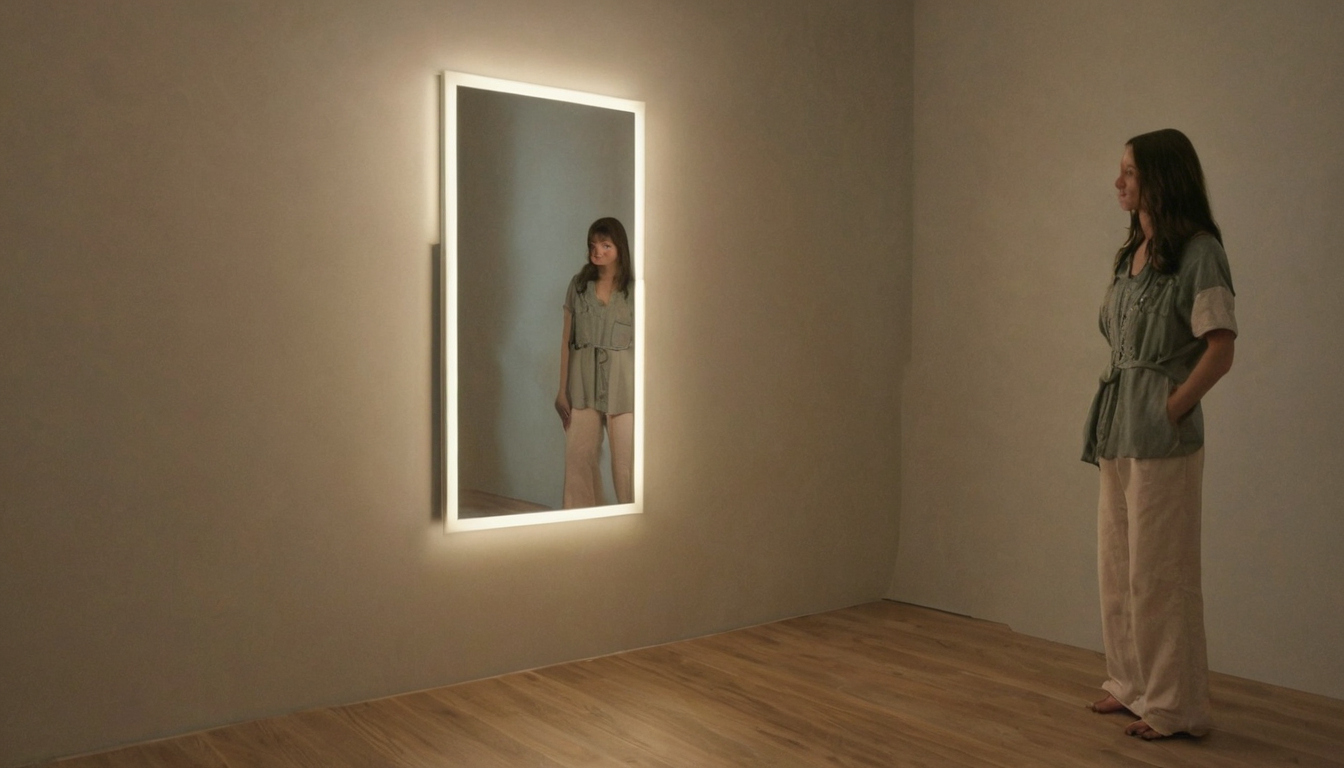
How should designers test floor mirror sightlines before choosing final light fittings shown with practical context cues.
- Concept stage: mark the intended mirror position on plan and elevation, including height, width, frame depth, and expected lean or fixing angle.
- Lighting layout: plot downlights, wall lights, coves, wardrobe lighting, pendants, and table lamps against standing, seated, bed-facing, and circulation sightlines.
- Electrical rough-in: review the test with the designer, electrician, mirror installer, and client before cable positions and ceiling apertures are fixed.
- Procurement: ask suppliers for beam angle, lumen output, cutoff or shielding description, dimming data, driver location, and lamp access.
- Commissioning: retest the installed mirror with live fittings, finished paint, furniture, curtains, and programmed scenes.
A reflected glare check should trace eye-to-mirror-to-source paths
A reflected glare check can start with a simple line test. On the plan, draw a line from the user’s eye position to the mirror surface, then reflect that line at the same angle toward the room. If the reflected line lands on an exposed lamp, bright downlight aperture, bare LED tape, or sunlit window patch, the user may see a hard source image.
The required inputs are practical: room plan, key elevations, mirror height, mirror width, mirror lean, luminaire position, window position, and user positions. A dressing area may need standing eye lines in front of wardrobe doors. A bedroom may need bed-facing and seated lines.
A site mock-up should use temporary tape, a movable mirror, and working lamp samples
A low-cost mock-up catches problems before procurement hardens. Painter’s tape can show the mirror outline on the wall or floor. A temporary mirror, reflective board, or borrowed full-height mirror can test the reflection. A sample lamp on a test circuit or dimmer can show whether the chosen aperture, lens, or shade is acceptable.
The mock-up should be checked in daylight, early evening, full night, and a dimmed scene. Phone photos are useful records, but automatic exposure can exaggerate or suppress glare. The client should stand in the room, turn naturally, and check the reflection from ordinary routes rather than one staged photograph.
Renovation sequencing matters. The U.S. Environmental Protection Agency identifies paints, varnishes, waxes, cleaning products, building materials, and furnishings as common indoor sources of volatile organic compounds, so fresh finishes and new furnishings should be tested with sensible ventilation.
A floor mirror should be retested after dimming scenes are programmed
A floor mirror can pass a daytime check and fail during an evening scene. Cleaning scenes often raise every source to a bright working level. Dressing scenes may combine wardrobe light, face light, and ceiling light. Accent scenes may leave one narrow beam or decorative lamp as the brightest object. Night scenes can make a small exposed diode feel harsher because surrounding surfaces are darker.
Dimming information should be requested before approval. The supplier should confirm compatible controls, minimum stable output, dimming curve, known flicker risks, and whether remote drivers will remain accessible.
Which luminaires are safest near floor mirrors?
The safest luminaires near floor mirrors are shielded, diffused, indirect, or aimed at matte surfaces rather than toward the mirror. In bedrooms, dressing rooms, and hotel suites, wall washers, shaded sconces, concealed coves, and well-cut-off adjustable spots usually outperform bare bulbs, exposed LED tape, and low pendants.
| Luminaire type | Mirror risk | Safer specification move |
|---|---|---|
| Recessed downlight | Bright aperture reflected at eye height | Use deep baffles, narrow aiming, and avoid the mirror’s reflected cone |
| Adjustable spot | Direct glare if the lamp face is visible | Specify cutoff, snoots, honeycomb louvres, and lockable aiming |
| Wall washer | Low risk if the mirror reflects the lit wall | Check beam spread, setback, and wall finish uniformity |
| Sconce | Medium risk if the shade exposes a lamp image | Use opaque or well-diffused shades and confirm side-view glare |
| Pendant | High risk near tall mirrors | Keep outside reflected sightlines or use fully shielded forms |
| Table lamp | Low to medium risk | Place the lamp so the shade, not the bulb, is reflected |
| Cove light | Low risk if the LED source is concealed | Check channel depth, driver access, dimming range, and ceiling brightness |
| LED strip | High risk when diodes appear as repeated dots | Use dot-free tape or diffused aluminium channels with careful concealment |
Shielding and cutoff matter more than raw lumen output beside a floor mirror
A high-lumen fitting can make a mirror zone less comfortable if the user sees the lamp image instead of the illuminated surface. The specification should ask for beam angle, cutoff description, lens or diffuser type, lumen output after optical losses, colour temperature, CRI, dimming method, and driver location.
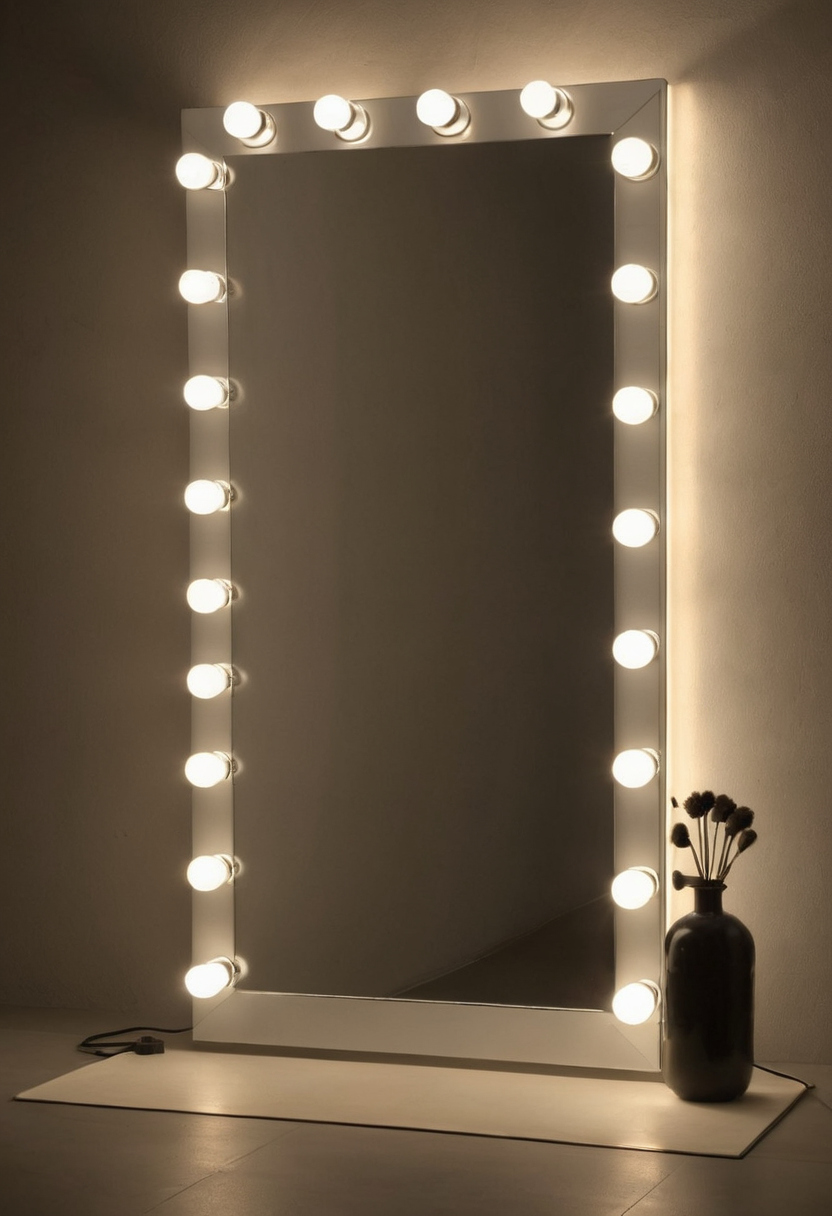
Which luminaires are safest near floor mirrors shown as an editorial planning reference.
Residential rooms can tolerate more variation because one owner learns the room’s habits. Hospitality interiors need stricter control because guests stand, sit, unpack, and circulate in unfamiliar positions. In hotel suites, serviceability also matters: a concealed driver or failed tape run behind joinery can turn a glare correction into a maintenance problem.
Exposed LED strips can create repeated hot spots in a mirror reflection
LED strip failures often appear in wardrobe reveals, open shelving, ceiling coves, and skirting details. A floor mirror can multiply every diode into a dotted line, so the detail must conceal the source from both the user’s direct view and the mirror’s reflected view.
The safer specification identifies dot-free COB tape or standard tape in a deep diffused channel, wattage per metre, aluminium heat sink, diffuser depth, colour temperature, dimming compatibility, and accessible driver position. Installation tolerance matters: a strip that shifts forward by a few millimetres can become visible in reflection.
How do windows and daylight affect floor mirror placement?
Floor mirrors can improve the feeling of daylight only when they redirect soft sky brightness or a lit wall, not harsh sun or an overexposed window. In apartments, villas, and hotel rooms with strong seasonal sun, mirror placement must be checked for morning, afternoon, and evening conditions.
Window orientation sets the first risk. An east-facing bedroom may reflect low morning sun into the bed. A west-facing hotel suite may catch late glare at standing eye height. A north-facing dressing room may gain useful softness from a mirror, while a south-facing living room may need sheers, blinds, or external shading before the mirror position is safe.
A floor mirror opposite a window can create brightness without comfort
A mirror directly opposite a window works only when the window view is controlled: shaded exposure, diffuse daylight, filtered curtains, or a soft exterior surface rather than a bright sky patch. The mirror may make the room photograph as brighter, but the user still sees a high-contrast aperture repeated in glass.
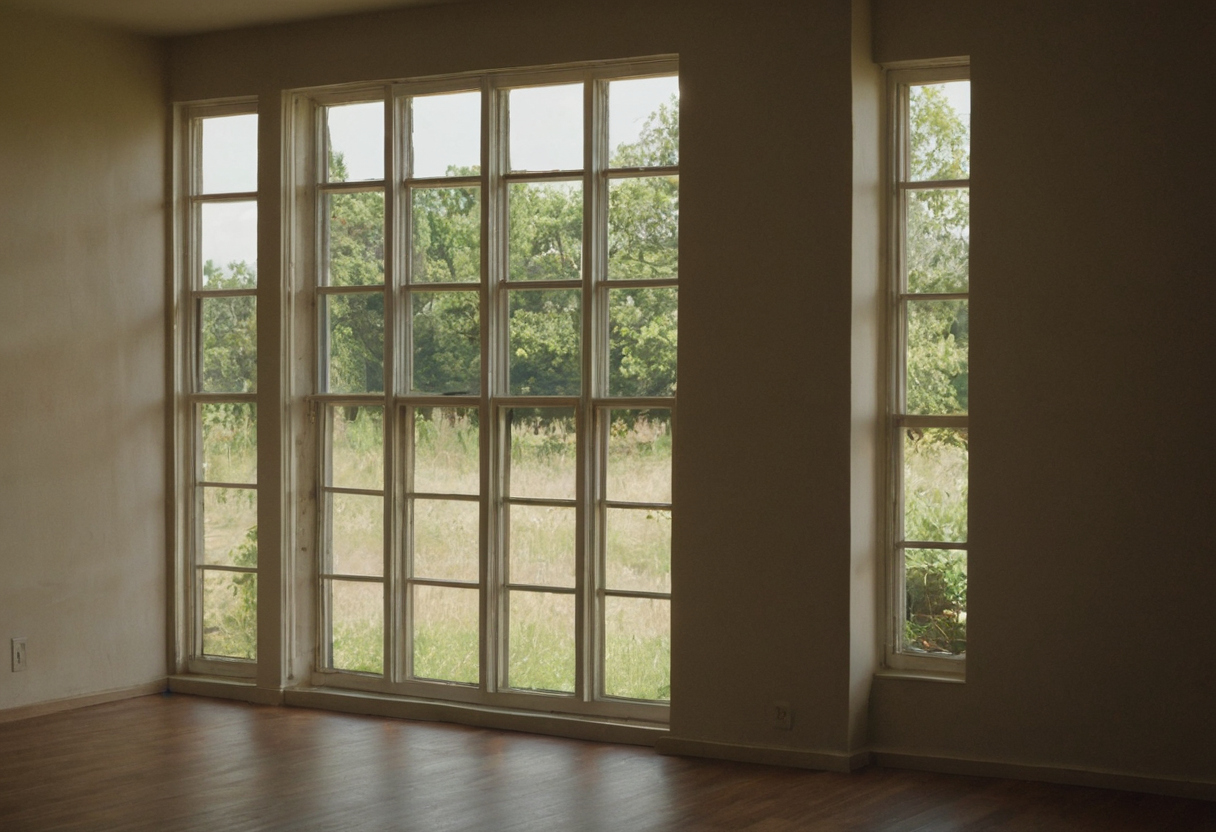
How do windows and daylight affect floor mirror placement shown as an editorial planning reference.
Opposite-window placement fails when direct sun, low sun angle, glossy flooring, or a white exterior wall creates a hard reflected image. In a dark hallway, the effect can be useful if the mirror catches a lit return wall. In a bedroom corner, the same move can put a bright rectangle into the user’s face while dressing or sitting on the bed.
Side placement usually gives more controlled daylight reflection than direct opposition
Side placement gives the designer more control because the mirror can borrow brightness without copying the window. A floor mirror perpendicular to the window wall can reflect a washed side wall. A mirror angled slightly toward a painted return can lift a deep living room without showing the sun source.
Mirror lean angle and frame depth change the reflected target. A shallow lean may catch ceiling brightness or a downlight aperture; a deeper lean may catch floor glare or a pale rug. Wall colour also matters: a warm matte wall gives a calmer reflection than a glossy white reveal beside the glass.
Why can floor mirrors create false brightness in lighting drawings?
Floor mirrors can make a room look brighter in visualisations because they duplicate luminous surfaces on screen, while the actual room may still lack useful task light. Reflected brightness should be separated from measured illuminance at the face, floor, wardrobe, vanity, or seating area.
A mirror can brighten a view without increasing useful task light
Perceived brightness is the impression created by bright surfaces in the field of view. Reflected luminance is the brightness of the wall, window, lamp, or ceiling patch seen in the mirror. Task illuminance is the light actually reaching the activity plane, such as a face at a dressing mirror, clothes inside a wardrobe, a book on a chair, or the floor along a night route.
A bedroom rendering may show a floor mirror reflecting a softly lit plaster wall, so the image feels open and luminous. The wardrobe beside the mirror can still remain dark if no light reaches the hanging rail. A hotel suite may show a mirror reflecting a window, while the user’s face remains in shadow because daylight is behind the body.
Renderings should label reflected light separately from working light
Lighting drawings should mark mirror effects as reflected views, not as extra working light. A useful note is: “Mirror reflection shown for visual expansion only; task light to be verified at face, wardrobe interior, vanity, reading position, and circulation route.”
Private gallery rooms and collection-led interiors need clearer documentation because preservation, access, and use may drive light exposure decisions. The National Park Service Museum Handbook provides guidance for museum collections preservation, documentation, access, and use.
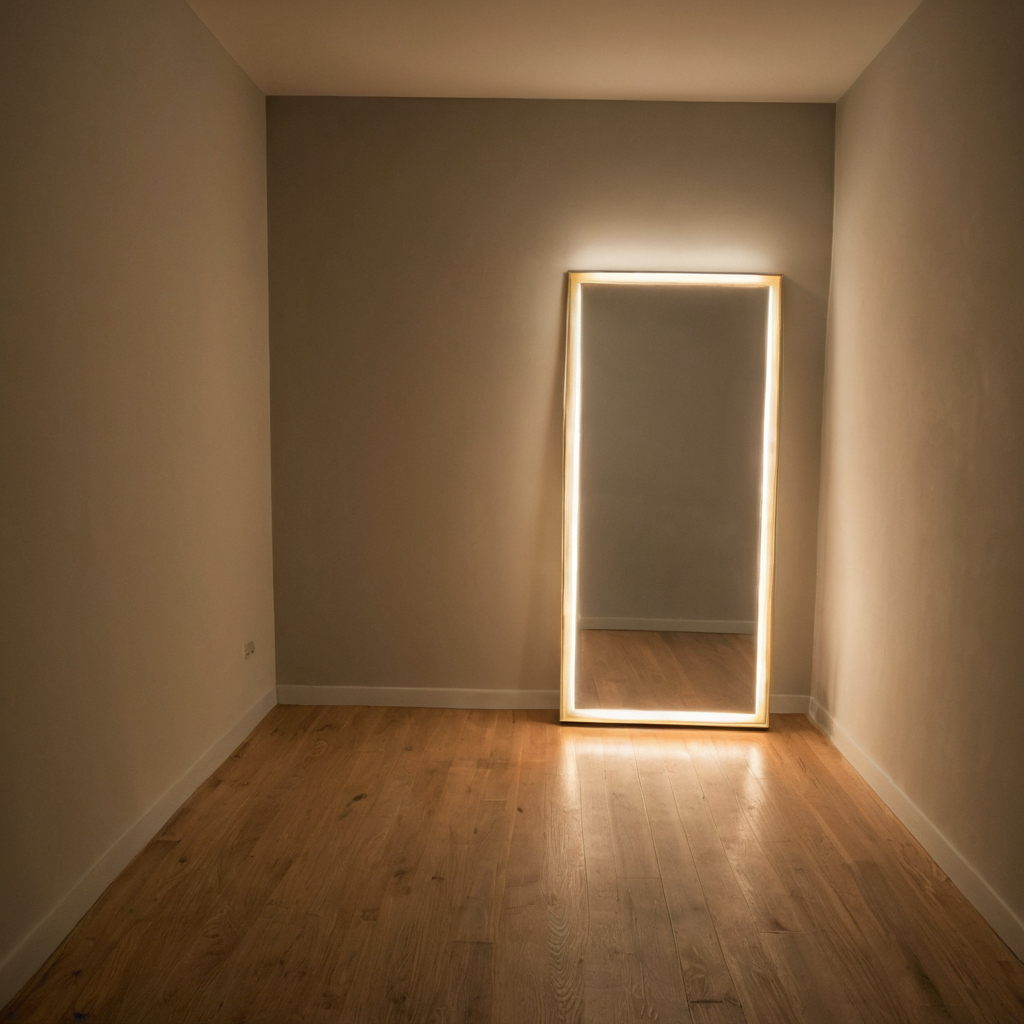
Why can floor mirrors create false brightness in lighting drawings shown as an editorial planning reference.
What specifications keep large floor mirrors safe, stable, and serviceable?
Large floor mirrors need safety backing, secure anchoring, realistic weight allowances, and access planning before the lighting layout is finalised. In homes, dressing rooms, rental apartments, and hotel suites, glare control is irrelevant if the mirror cannot be safely fixed, cleaned, moved, or protected from impact.
A floor mirror specification should include glass type, safety backing, frame depth, and fixing method
A floor mirror order should not rely on height, width, and finish alone. The supplier schedule should name the mirror glass type, glass thickness, safety backing or laminated construction, edge treatment, frame material, frame depth, total weight, and the proposed anti-tip system.
The fixing method should suit the room risk. A wall strap may suit a low-traffic bedroom, while a concealed bracket, built-in joinery slot, freestanding weighted frame, or positive anti-tip fixing is usually safer in a hotel suite, rental apartment, family dressing room, or hallway where children, pets, luggage, housekeeping trolleys, or frequent turnover can strike the frame.
The installer should confirm the substrate before procurement. Plasterboard needs studs, pattresses, or rated cavity fixings. Masonry may take direct anchors. Wardrobe carcasses need structural confirmation rather than decorative panel fixing. Stone or tiled walls require drilling coordination, crack control, and spare tile allowances.
The mirror fixing should be coordinated before electrical rough-in
The mirror zone should be frozen before sockets, switches, wall sconces, LED drivers, junction boxes, and wardrobe lighting cables are set out. A bracket that lands behind a switch plate or driver access panel can force the mirror into a worse reflected-glare position after the lighting design has been approved.
- Set the mirror footprint, tilt, and fixing height on the elevation.
- Mark bracket, strap, or joinery-slot positions on site.
- Route cables around the fixing zone, not through it.
- Approve nearby luminaire positions from the actual mirror sightline.
- Photograph cables, noggins, and anchors before wall closure.
Specify the floor mirror as fixed equipment in the lighting package, not as late furniture, so safety, service access, and reflected glare are resolved before walls close.
FAQ
How do you avoid glare when using floor mirrors in a lighting plan?
Place the mirror so it reflects lit walls, curtains, joinery, or indirect light rather than exposed lamps, downlight apertures, LED strips, or bright window patches. Test standing, seated, bed-facing, and circulation sightlines before electrical rough-in.
Do floor mirrors actually make a room brighter or only make it look brighter?
Floor mirrors can make a room look brighter by reflecting luminous surfaces, but they do not replace task light. Check light at the face, wardrobe, floor, vanity, desk, or reading position rather than relying on the reflected view.
Should a floor mirror go opposite a window to reflect natural light?
A floor mirror should go opposite a window only when the window light is diffuse and controlled. Side placement is often safer because the mirror can borrow daylight from a lit wall without reflecting direct sun or a bright sky patch.