
Sarelli Textiles belongs in any serious discussion of luxury dressing rooms because the room succeeds or fails at the level of material performance before it succeeds as decoration. A bespoke wardrobe space is not just a backdrop for mirrors and cabinetry. It is a high-contact interior with repeated brushing against garments, frequent hand contact at seating and panel edges, changing humidity after showers, concentrated artificial lighting, and in many homes a daily cycle of daylight that can flatten or fade sensitive surfaces over time.
That is why the best dressing rooms are specified like small textile environments. The logic starts with exposure. The U.S. Environmental Protection Agency notes that people spend about 90 percent of their time indoors, and indoor pollutant levels can be as high as or higher than outdoor levels. In practical terms, dressing rooms are not occasional show spaces. They are daily-use interiors, and that changes how fabric decisions should be made. Surface beauty matters, but abrasion behavior, pile structure, moisture response, dust management, and light discipline matter first. Source: EPA indoor air quality exposure research.
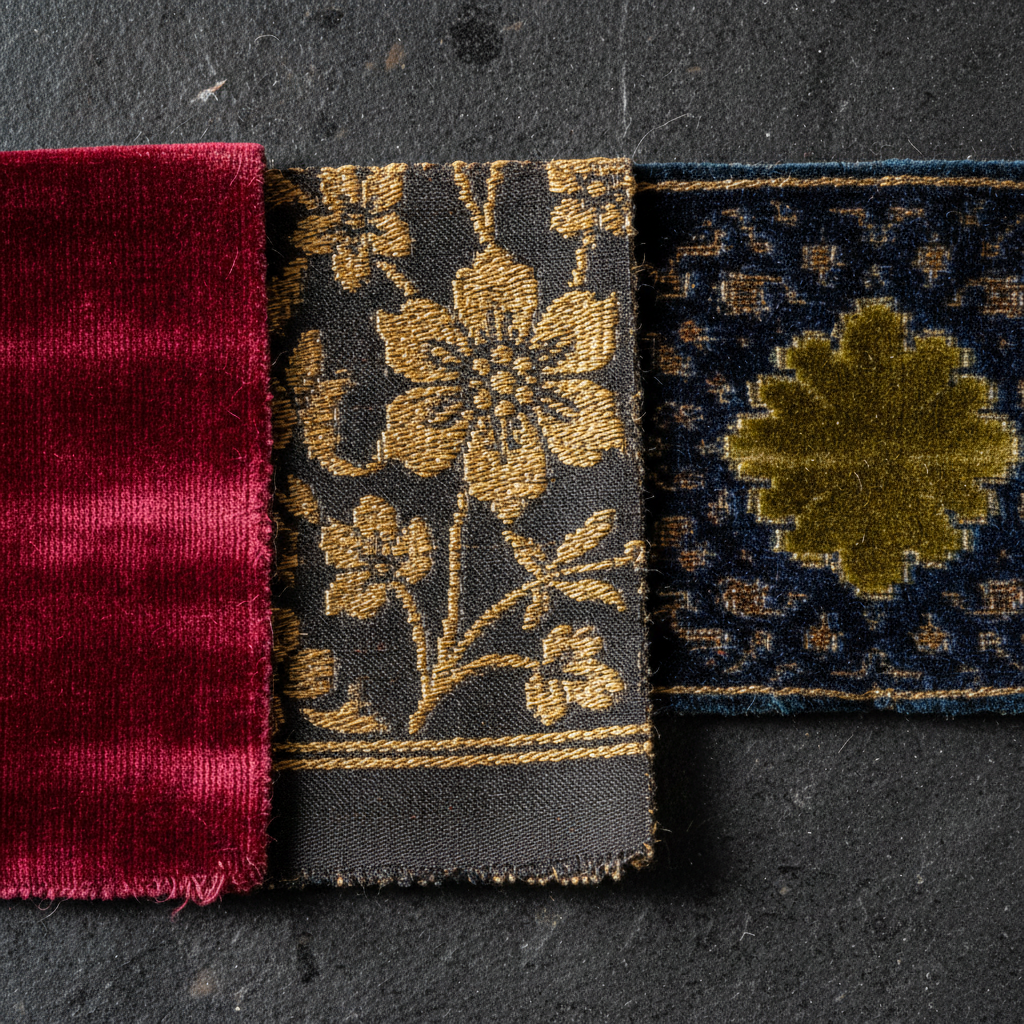
The textile history is useful here because it shows that luxury fabrics have always been technical objects, not just decorative ones. The Metropolitan Museum of Art describes one Italian velvet panel from the second half of the 15th century as silk and metal-wrapped thread in a pile-on-pile cut, voided, and brocaded velvet structure. The museum also notes that later 15th-century technical innovations made velvets more complex through different cut-pile heights and supplementary metal threads. That is an important design lesson for a dressing room: texture is often created by structure, not by applied excess. A wall panel in a wardrobe lounge, an upholstered stool, or a jewelry display niche can feel richer when the textile has depth built into the weave rather than loud contrast built into the palette. Source: The Met, Panel of velvet, Italian, second half 15th century.
For that reason, the first technical question in a bespoke dressing room is not “Which color looks expensive?” It is “Where will the fabric be touched, compressed, grazed, and lit?” Cut velvet on a rarely touched wall panel can produce a slow, soft shift in reflected light that reads better than a glossy hard finish. The same cloth on a tight bench edge that takes constant friction from denim hardware and handbags may not be the smartest choice. A room planned around engineering starts by zoning the textiles: high-contact surfaces, low-contact surfaces, floor surfaces, and accent surfaces. Once those zones are clear, the visual language usually becomes more convincing on its own.
Moisture response is the next issue. Woolmark states that wool is hygroscopic and can absorb up to 35% of its weight before feeling wet. That is usually discussed in apparel, but the material principle matters for interiors as well. In a dressing room, a wool-rich rug or carpet can help the room feel less brittle under changing humidity and foot traffic than a harder, less forgiving floor finish. It also helps explain why rugs in wardrobe spaces should not be treated as an afterthought. The floor is where the room takes its daily physical load. If the surface underfoot feels unstable, overly slick, or acoustically sharp, the room loses a large share of its luxury effect. Source: Woolmark, Wool is naturally breathable.
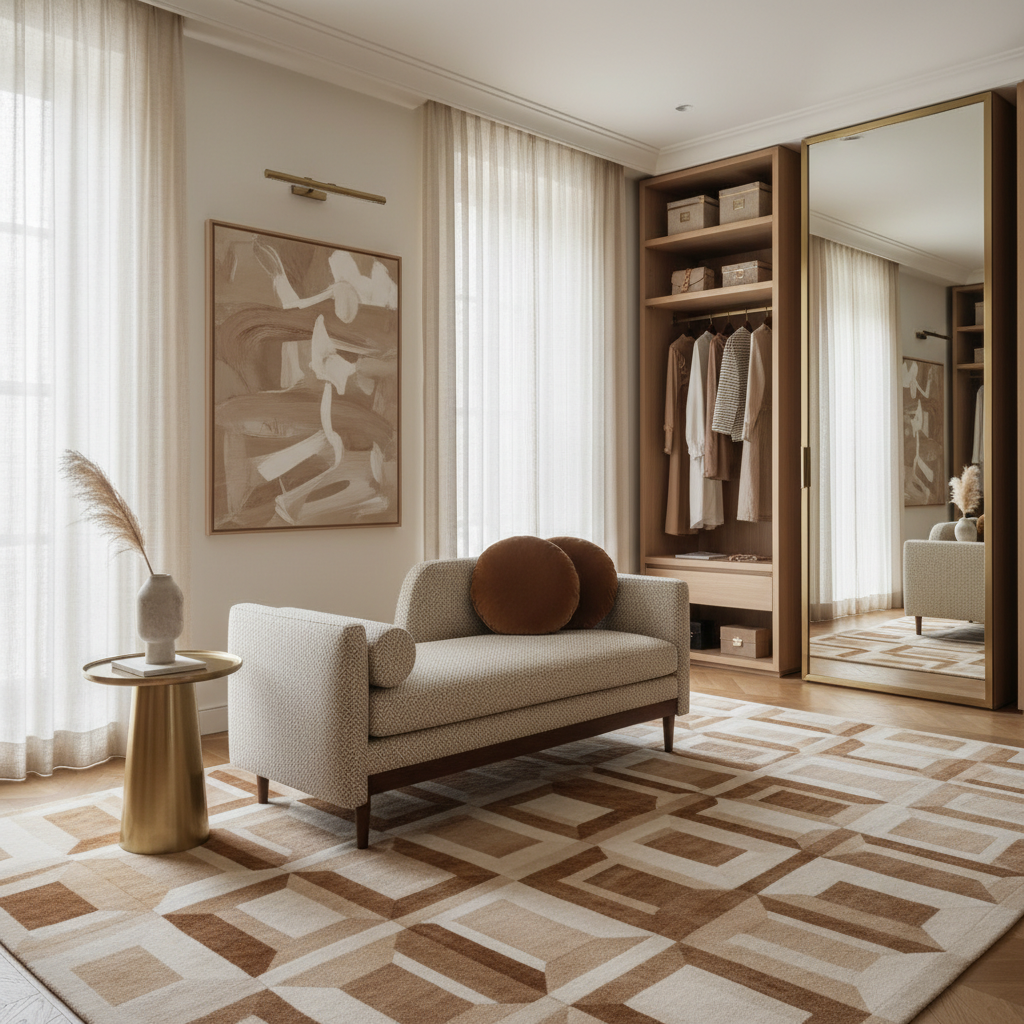
Light exposure is where many luxury dressing rooms quietly fail. Designers often chase bright illumination for mirrors and photography-ready finishes, but textile conservation work points in the opposite direction: precious surfaces need disciplined light management. The Victoria and Albert Museum’s presentation of the Ardabil Carpet is a strong example. The museum notes that the carpet is illuminated for only 10 minutes on the hour and half hour in order to preserve its color. The same article records about 5,300 knots per ten square centimetres and notes that as many as 10 weavers may have worked on the piece. Those facts are usually read as evidence of status and labor. They also support a more practical conclusion: when material complexity is high, exposure control becomes part of the design, not a maintenance footnote. Source: V&A, The Ardabil Carpet.
In a modern dressing room that means several specific decisions. Window treatment should be designed before fabric selection, not after it. Integrated lighting should avoid direct glare onto pile fabrics. Display shelves for handbags, scarves, and jewelry should be lit with aim and lux levels in mind, especially when silk-rich panels or rugs sit in the same view line. If a room has natural light, the textile plan should assume rotation. The V&A’s conservation report on the Bullerswood Carpet discusses rotation and careful vacuuming as part of preservation practice. The piece itself measures 4 by 7.6 metres and combines cotton warp, jute weft, and woollen pile. The lesson is plain: large soft surfaces remain stable through management, not neglect. Source: V&A, The conservation of the Bullerswood Carpet.
Silk adds another layer. Britannica’s overview of sericulture is useful not because it is glamorous, but because it reminds the reader that silk begins as a biological filament with very specific processing steps. That origin still shows up in how silk behaves in finished interiors: luster, smooth handle, and sharp pattern reading are not accidents. They come from the fiber itself and from how the cloth is finished. In a dressing room, silk-rich textiles work best where the eye reads them before the hand attacks them. Panel inserts, framed textile moments, lined screen surfaces, and low-contact ottomans are safer placements than heavily used seat fronts or narrow pull-out bench cushions. Source: Britannica, Sericulture.
That distinction between visual zone and wear zone is what separates a bespoke room from a merely expensive room. Expensive rooms often place delicate fabrics anywhere they look good in a render. Bespoke rooms place each textile where its structure makes sense. A pile fabric may belong on a panel that catches oblique light. A dense woven silk may belong on a screen or cabinet insert. A wool or wool-silk rug may belong at the center because it handles step count, sound control, and visual grounding better than a polished hard floor alone. The design gets stronger once every textile has a workload it can actually carry.
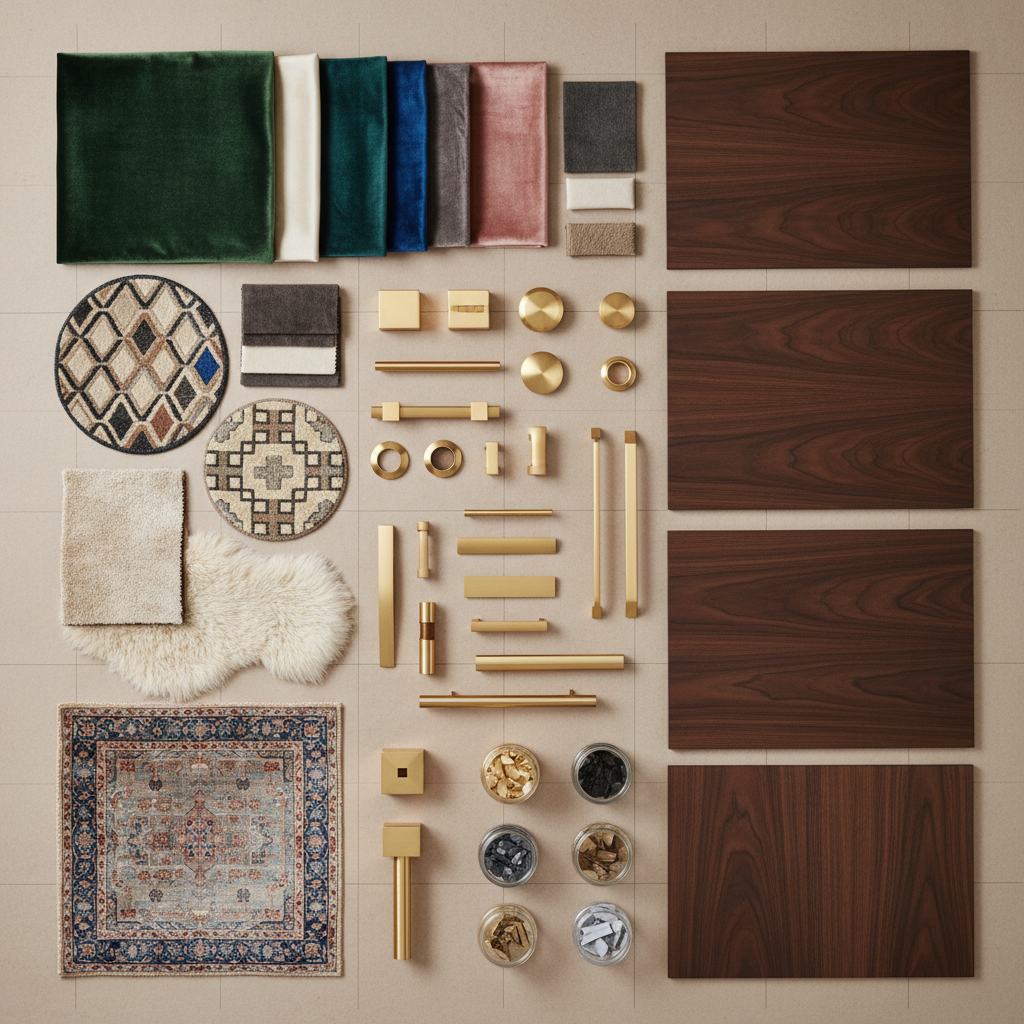
There is also an acoustic point that clients notice even when they do not name it. Soft surfaces change the room’s sound profile. Rugs, lined wall sections, and upholstered seating reduce the hard echo that can make even a large luxury dressing room feel cold. That matters in wardrobe rooms because people often use them at low volume and at close range: early mornings, evening routines, conversations during fittings, quiet time around mirrors and vanities. When the sound is controlled, the room feels more private, and privacy is one of the clearest markers of luxury.
For this reason, the best dressing rooms should be specified in a sequence. First define exposure: daylight, lighting angle, hand contact, foot traffic, and cleaning frequency. Then define the textile zones. Only after that should pattern, sheen, and palette be finalized. The order matters. The room has to survive before it can impress. That is why fabric engineering comes before ornament. Ornament is what the visitor notices first. Engineering is what keeps the room worth noticing after years of use.
A final practical benchmark is reversibility. If a room uses highly specific panels, rug formats, or upholstered inserts, the design should still allow selective replacement rather than total rework. Museum conservation is built on controlled intervention, and high-end interiors benefit from the same discipline. In a bespoke dressing room, this can mean separately upholstered panels, bordered rugs sized to furniture geometry, and trims that can be refreshed without removing whole assemblies. The room then ages in a controlled way rather than breaking down unevenly.
That is the real advantage of luxury textile thinking. It is not nostalgia, and it is not visual excess. It is control over touch, light, sound, and wear. In a room designed for clothing, jewelry, and private routine, those factors are not secondary details. They are the operating system of the space.
Sources
- US EPA – Indoor Air Quality Exposure and Characterization Research
- The Metropolitan Museum of Art – Panel of velvet, Italian, second half 15th century
- The Woolmark Company – Wool is naturally breathable
- V&A – The Ardabil Carpet
- V&A – The conservation of the Bullerswood Carpet
- Encyclopaedia Britannica – Sericulture